The Kinsey Scale: What It Is, How It Works, and What Your Number Really Means
The Kinsey Scale is one of the most recognized frameworks for understanding human sexuality — and one of the most frequently searched. Whether you are curious about where you fall on the scale, wondering what a "Kinsey 2" actually means, or looking for a Kinsey Scale test you can take online, this guide covers everything you need to know. We will walk through the history behind the scale, explain each number from 0 to 6, discuss its limitations, and point you toward modern tools that go even further. If you are ready to explore your own sexuality in a private, supportive environment, you can start with a free sexuality test designed for self-reflection — not diagnosis.
What Is the Kinsey Scale?
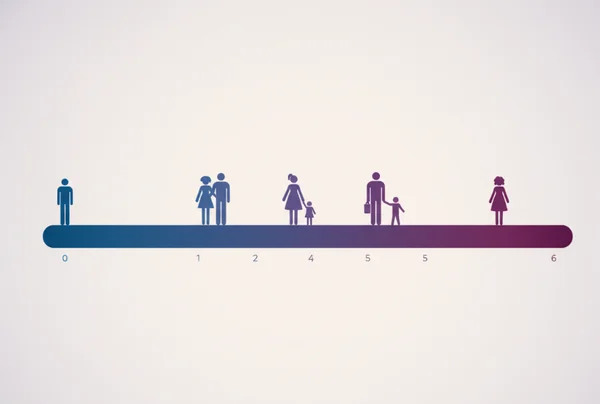
The Kinsey Scale — officially called the Heterosexual-Homosexual Rating Scale — is a 7-point classification system that plots sexual orientation along a continuum rather than into two rigid categories. Instead of labeling someone as simply "heterosexual" or "homosexual," the scale recognizes that most people fall somewhere in between.
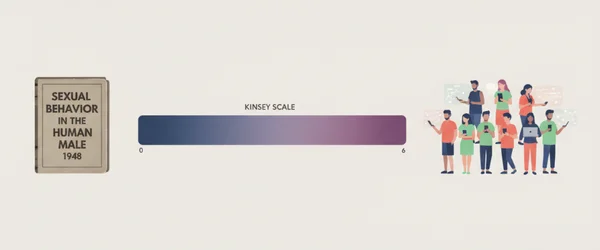
The scale was developed by Dr. Alfred Kinsey and his colleagues at Indiana University and first published in Sexual Behavior in the Human Male in 1948. It was later applied to women as well in Sexual Behavior in the Human Female (1953).
Why it mattered then: Before Kinsey's research, public understanding of sexuality was largely binary — you were either straight or gay. By interviewing thousands of people about their sexual histories, Kinsey demonstrated that human sexuality is far more nuanced than society had acknowledged.
Why it still matters now: The Kinsey Scale laid the groundwork for every modern conversation about the sexuality spectrum. While newer models have emerged, the basic insight — that sexuality exists on a continuum — remains one of the most important contributions to the field.
The Kinsey Scale: Numbers 0 to 6 Explained
Each number on the Kinsey Scale represents a different position along the heterosexual-homosexual continuum. Here is what each one means.
| Rating | Description | What It Means |
|---|---|---|
| 0 | Exclusively heterosexual | Attracted only to the opposite sex, with no same-sex attraction or experience |
| 1 | Predominantly heterosexual, only incidentally homosexual | Mostly attracted to the opposite sex, with rare or minor same-sex attraction |
| 2 | Predominantly heterosexual, but more than incidentally homosexual | Primarily opposite-sex attracted, but with notable same-sex attraction or experiences |
| 3 | Equally heterosexual and homosexual | Roughly equal attraction to both sexes — often associated with bisexuality |
| 4 | Predominantly homosexual, but more than incidentally heterosexual | Primarily same-sex attracted, but with notable opposite-sex attraction or experiences |
| 5 | Predominantly homosexual, only incidentally heterosexual | Mostly attracted to the same sex, with rare or minor opposite-sex attraction |
| 6 | Exclusively homosexual | Attracted only to the same sex, with no opposite-sex attraction or experience |
| X | No socio-sexual contacts or reactions | Often interpreted as asexuality — no notable sexual attraction to either sex |
What Does "Kinsey Scale 2" Mean?
A Kinsey 2 is one of the most commonly searched ratings. It describes someone who is predominantly heterosexual but with more than incidental homosexual attraction. In practical terms, this might describe someone who primarily dates and is attracted to the opposite sex but occasionally notices or feels attraction toward the same sex — and not just as a fleeting thought.
Many people who score a 2 on Kinsey-style assessments relate to modern labels like "heteroflexible" or identify somewhere on the bisexual spectrum.
What Does "Kinsey Scale 3" Mean?
A Kinsey 3 represents the midpoint — someone who experiences roughly equal attraction to both sexes. This is often associated with bisexuality, though the experience varies widely from person to person. Some Kinsey 3s feel strongly attracted to multiple genders; others may experience moderate attraction across the board.
How to Take a Kinsey Scale Test
Kinsey himself did not design a standardized test or quiz. His team assigned ratings based on extensive personal interviews about sexual behavior and psychological responses. However, many online resources now offer Kinsey-style assessments — questionnaires that help you estimate where you might fall on the 0-to-6 spectrum.
What to look for in a quality Kinsey Scale test:
- It should ask about both attraction (who you are drawn to) and experience (who you have been involved with)
- It should be confidential and not require personal information to see results
- It should present results as a starting point for self-reflection, not a definitive diagnosis
- It should acknowledge the limitations of any single scale
If you are looking for a modern, research-informed alternative that goes beyond the original Kinsey framework, the sexuality self-exploration quiz at SexualityTest.org assesses multiple dimensions of attraction and offers an optional AI-powered personalized report for deeper insights.
Why the Kinsey Scale Still Matters
Despite being over 75 years old, the Kinsey Scale remains culturally significant for several reasons.
It Normalized the Spectrum
Before Kinsey, the dominant narrative was binary: you were either heterosexual or homosexual. Kinsey's research showed that a significant percentage of people had experienced some level of attraction or behavior that did not fit neatly into either category. This finding was revolutionary — and it gave millions of people permission to see their own experiences as normal.
It Challenged Stigma
By demonstrating that same-sex attraction was far more common than society assumed, Kinsey's work helped chip away at the stigma surrounding homosexuality and bisexuality. His research was instrumental in the eventual removal of homosexuality from the DSM (Diagnostic and Statistical Manual of Mental Disorders) in 1973.
It Created a Common Language
The Kinsey Scale gave people a vocabulary to discuss sexuality in graduated terms. Saying "I'm probably a 2" or "I think I'm a 4" became a shorthand for communicating nuanced feelings about attraction — something that was nearly impossible with the binary language available before.
Limitations and Criticisms of the Kinsey Scale
While groundbreaking, the Kinsey Scale has real limitations that are worth understanding. Modern researchers and LGBTQ+ advocates have identified several key issues.
It Treats Sexuality as a Single Axis
The Kinsey Scale assumes that heterosexual and homosexual attraction are opposite ends of one line — meaning more of one equals less of the other. But this is not how many people experience attraction. Someone can feel strong attraction to multiple genders simultaneously, or minimal attraction to any gender. A single axis cannot capture that complexity.
It Focuses on Behavior and Attraction, Not Identity
The scale was designed to measure observable behavior and reported psychological reactions. It does not account for how someone identifies — which is a crucial part of modern understanding of sexuality. A person's behavior may not align with their identity, and both are valid.
It Assumes a Gender Binary
The Kinsey Scale operates within a framework of "male" and "female." It does not account for non-binary, genderqueer, or gender-fluid individuals, nor does it address attraction to people outside the binary.
It Does Not Fully Represent Asexuality
The "X" category was Kinsey's acknowledgment that some people reported no sexual reactions. However, modern understanding of asexuality is far richer — it includes a wide spectrum of experiences that a single supplementary category cannot capture.
Sample Bias in the Original Research
Kinsey's interview subjects included a disproportionate number of prisoners and college students, and excluded African Americans from the data. This sampling bias means the original findings may not have been fully representative.
Beyond the Kinsey Scale: Modern Frameworks for Understanding Sexuality
Today, researchers and clinicians use more sophisticated models that address the Kinsey Scale's limitations. Here are some of the most notable alternatives.
The Klein Sexual Orientation Grid
Developed by Fritz Klein in 1978, this model evaluates seven different dimensions of sexuality — including attraction, behavior, fantasies, emotional preference, social preference, self-identification, and lifestyle — across past, present, and ideal categories. It provides a much more detailed picture than a single number.
The Storms Model
Michael Storms proposed a two-dimensional model that plots heterosexual and homosexual attraction on separate axes. This allows for high attraction to both genders (bisexuality) and low attraction to all genders (asexuality) to be represented independently.
The Genderbread Person
This educational model separates gender identity, gender expression, biological sex, and sexual/romantic attraction into distinct dimensions — acknowledging that these are all independent aspects of a person's identity.
Modern Multidimensional Approaches
Contemporary sexuality research increasingly recognizes at least three independent components:
- Sexual attraction — who you are physically drawn to
- Romantic attraction — who you form emotional bonds with
- Sexual identity — the label you use for yourself
These components do not always align, and that is completely normal. Someone might experience sexual attraction to multiple genders but romantic attraction primarily to one, for example.
If you want to explore your own sexuality using a framework that considers multiple dimensions — not just a single number — the SexualityTest.org quiz offers a confidential, modern assessment with optional AI-powered personalized insights.
Your Scale, Your Story
The Kinsey Scale was a starting point — not the final word. It opened the door to understanding sexuality as a spectrum, and that insight remains profound. But your experience of attraction, identity, and connection is more complex than any single number can capture.
Whether you identify as a 0, a 3, a 6, an X, or somewhere entirely off the traditional scale, your feelings are valid. The most important thing is not where you land on someone else's system — it is how well you understand yourself.
This article is for educational and informational purposes only. It is not clinical advice or a diagnostic tool. If you are exploring your sexual orientation and need support, consider speaking with an LGBTQ+-affirming therapist or counselor.
Frequently Asked Questions
What is the Kinsey Scale?
The Kinsey Scale is a 7-point rating system (0 to 6, plus X) that classifies sexual orientation along a continuum from exclusively heterosexual (0) to exclusively homosexual (6). It was developed by Dr. Alfred Kinsey in 1948 to show that sexuality exists on a spectrum rather than as a binary.
How do I take a Kinsey Scale test?
Kinsey did not create a standardized test — he assigned ratings through interviews. Today, many websites offer Kinsey-style questionnaires that ask about your attraction patterns and experiences to estimate your position on the scale. For a more comprehensive assessment, try a free online sexuality quiz that goes beyond the basic Kinsey framework.
What does a 2 on the Kinsey Scale mean?
A Kinsey 2 means "predominantly heterosexual, but more than incidentally homosexual." This describes someone who is mainly attracted to the opposite sex but has notable and recurring same-sex attraction that goes beyond occasional or passing interest.
Is the Kinsey Scale still accurate?
The Kinsey Scale remains a useful starting point for understanding sexuality as a spectrum, but it has significant limitations. It does not account for modern understandings of gender diversity, asexuality, romantic versus sexual attraction, or the distinction between attraction and identity. More comprehensive models now exist.
What is the significance of the Kinsey Scale?
The Kinsey Scale was revolutionary because it challenged the binary view of sexuality that dominated mid-20th-century thinking. By showing that many people's experiences fell between "exclusively heterosexual" and "exclusively homosexual," it normalized the idea of a sexuality spectrum and laid the foundation for modern LGBTQ+ research and advocacy.
Can your Kinsey Scale number change over time?
Yes. Kinsey himself suggested that the scale represents a person's orientation at a given time, not necessarily a permanent state. Modern research supports the concept of sexual fluidity — the idea that attraction patterns can shift over the course of a person's life.
What does Kinsey X mean?
The X category on the Kinsey Scale was used for individuals who reported "no socio-sexual contacts or reactions." Today, this is most commonly understood as an early acknowledgment of asexuality — though modern understanding of the asexual spectrum is far more nuanced than a single category can capture.